
Criminal Court Cases in Florence County
Florence County Circuit Court is the county's single general-jurisdiction trial court. It hears felony, misdemeanor, and criminal-traffic matters. There is no Florence County municipal court and no separate lower court for misdemeanors. The District Attorney files a prosecution, while the Clerk of Circuit Court creates and maintains the case file. That compact structure helps: every local criminal complaint, motion, judgment, and sentencing record routes to the same clerk rather than several court systems.
Wisconsin case numbers also flag the kind of proceeding. A CF code marks a criminal felony, CM marks a criminal misdemeanor, and CT marks criminal traffic. One Florence County case can contain several counts with different statutes, pleas, and dispositions. Read each count on its own. The caption or lead charge is not a safe summary of the final judgment.
One Florence County Criminal Court
The local court directory makes the jurisdiction plain: Florence County has one circuit branch in Wisconsin's Ninth Judicial Administrative District. Judge Leon D. Stenz is listed for the county. The circuit clerk, not the sheriff or prosecutor, is the authoritative source for filed pleadings, signed judgments, docket questions, fines, and court-ordered duties.
The Florence County Clerk of Circuit Court is at 501 Lake Avenue, P.O. Box 410, Florence, WI 54121. Jessica McCoy is the elected clerk. The counter is open weekdays from 8:30 a.m. to 4:00 p.m.; call 715-528-3205 or fax 715-528-5470. Give the case number whenever possible and name the exact item needed, such as the complaint, information, judgment of conviction, sentencing transcript, or certified docket.
Florence County Case Record Searches
Wisconsin Circuit Court Access, often called WCCA or CCAP, is the free statewide starting point. It presents public docket information after a terms notice. Florence County searches work best when the county filter is set to Florence and the reader compares names with a birth date or known case number. A shared name alone is weak proof of identity.
- Open WCCA through the circuit-court search and accept its terms.
- Choose Party Name for discovery or Case Number when the exact file number is known.
- Set County to Florence, then narrow by name, birth date, case type, status, or filing period as needed.
- Open the result and read charges, pleas, dispositions, events, sentence, future activity, and financial summary.
- Contact the Florence County clerk for inspection, document copies, transcripts, or certification.
| WCCA Field | Type | Required | Use |
|---|---|---|---|
| Last Name | Text | Typical for party search | Use the legal surname; aliases may form separate rows. |
| First or Middle Name | Text | Optional | Narrows common-name results. |
| Birth Date | Date | Optional | Helps distinguish criminal defendants with similar names. |
| County | Dropdown | Optional | Select Florence for local cases. |
| Case Number | Text | Yes in that mode | Uses a year, CF/CM/CT code, and sequence. |
| Status or Filing Date | Filter | Optional | Narrows open, closed, or date-bound results. |
The official WCCA search screen shows the countywide public access point.
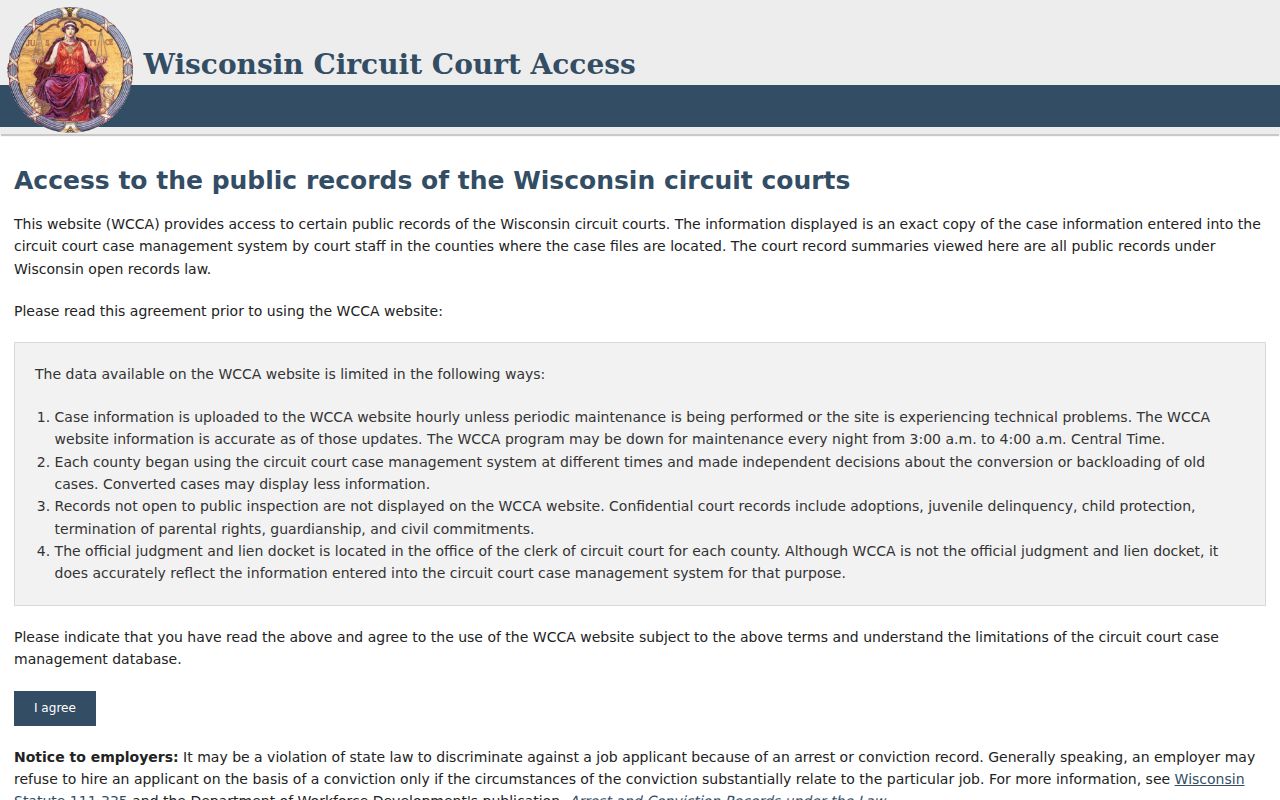
That screen leads to docket data, while the Florence County clerk remains the custodian of the official court record.
Florence County Case Search Limits
WCCA is an access view, not a warehouse of every filed page. The Wisconsin court system's CCAP overview explains the statewide electronic system and courthouse access.
The statewide design lets a Florence County reader find a docket from home, yet a courthouse terminal or clerk request may be needed for material that is not available through the public web view.
A common mistake is expecting a complaint PDF beside the event entry. WCCA generally provides indexed data, not the full document-image set. Ask the clerk to inspect or copy the complaint, information, written order, or judgment. Certification matters when an official copy is required. Published Florence sources do not state a certified-copy fee, so ask the clerk for the current cost before ordering.
What a Criminal Case File Contains
A Florence County criminal case file joins the formal accusations with the court's event history and result. The online docket helps locate the right matter. The clerk's file supplies the filed documents that support those entries. Charges can change between complaint, information, plea, and judgment, which is why the most recent signed disposition deserves more weight than the first charge label.
| Case Header | County, case number, caption, filing date, case type, status, branch, and judge. |
|---|---|
| Parties | State, defendant, birth date in criminal matters, prosecutor, and defense attorney where entered. |
| Charge Counts | Description, statute, severity, offense date, plea, disposition, and disposition date for each count. |
| Court Record | Filed complaint, appearances, hearings, motions, pleas, trial, sentencing, warrants, and later reviews. |
| Sentence | Jail or confinement, probation or supervision, credit, costs, restitution, and conditions. |
| Future and Financial | Upcoming activity, assessments, payments, balances, and collection entries when public. |
A “closed” label usually reflects final judgment. It does not promise that every obligation or later event is finished.
Reading Florence County Case Events
The event list is a timeline, not a prose account. “Complaint filed” starts the court file. An initial appearance addresses the accusation and release terms. In a felony, a preliminary hearing can test probable cause before an information and arraignment. A plea hearing records the defendant's answer to charges. Sentencing follows a conviction by plea or trial, while a dismissal or acquittal is a different disposition.
Read the charge table beside the event list. An amended count may retain an early event while the final judgment reflects a less serious or different offense. Future activities flag hearings not yet held. Later entries may concern restitution, probation review, a warrant, satisfaction, or appeal. Florence County readers should use the case number when calling the clerk so staff can distinguish similar names and related files.
Criminal Case Stages in Florence County
A local arrest does not itself open a circuit case. The arresting agency sends referral material to the District Attorney, who decides whether and what to charge. Once a complaint is filed, the Florence County clerk assigns the case number and records each court event. Some cases resolve through a plea, some go to trial, and others end without a conviction.
Case flow: Charges Filed › Arraignment › Pretrial › Plea or Trial › Disposition › Sentencing
This court timeline differs from the sheriff's arrest and booking record. For the custody-side trail before charging, use the Florence County arrest search channels. The court docket becomes the better source after charges are filed because it records pleas, judicial rulings, and the outcome.
Florence County Criminal Court Rules
Florence County's signed 2024 local rules add detail that a statewide docket cannot show. Counsel must communicate plea status and expected sentencing needs, furnish plea questionnaire and waiver materials, and prepare the information needed for sentencing. The rules also address scheduling, motions, remote appearances, and transcript practice.
Check the signed Florence County local rules before relying on practice from another Wisconsin county. The file was a manifest source but its screenshot capture failed, so no unverified image is displayed. For payment, the clerk lists cash-bail location code 4542 and fines or fees code 4543. Online convenience charges may apply, and the case number and amount should be confirmed before payment.
The rules are useful for reading a docket as well as preparing for court. A plea-status entry may reflect counsel's required communication, while a sentencing date can carry preparation duties not spelled out in the brief WCCA event line. Remote appearance and transcript questions should be checked against the signed Florence County rules and then confirmed with the clerk. Local practice can change, and a statewide search result is not a substitute for a current scheduling instruction.
Access Rules for Case Records
Wisconsin law favors public access, but it does not make every Florence County criminal case field public. Juvenile matters, sealed files, protected victim and citizen-witness data, juror identifiers, Social Security numbers, payment-card data, and security codes may be withheld or excluded. The clerk may release a redacted record when protected content can be separated from public material.
The Wisconsin court redaction FAQ distinguishes the public WCCA view from courthouse documents.
That distinction explains why a public event may appear even when its underlying document must be inspected at the Florence County courthouse or is partly shielded.
If a known Florence County case does not appear, check the spelling, case type, county filter, filing year, and case number before drawing a conclusion. Then contact the clerk. The matter may be too new for the public view, sealed or confidential, entered under a different name, or available only through courthouse access. Ask for the public portions of the identified file instead of requesting an unrestricted search across unrelated records.
Florence County Court Expungement Orders
Wisconsin expungement is narrow. Under Wis. Stat. § 973.015, the sentencing court generally must order it at sentencing when the case and person meet the statute's conditions.
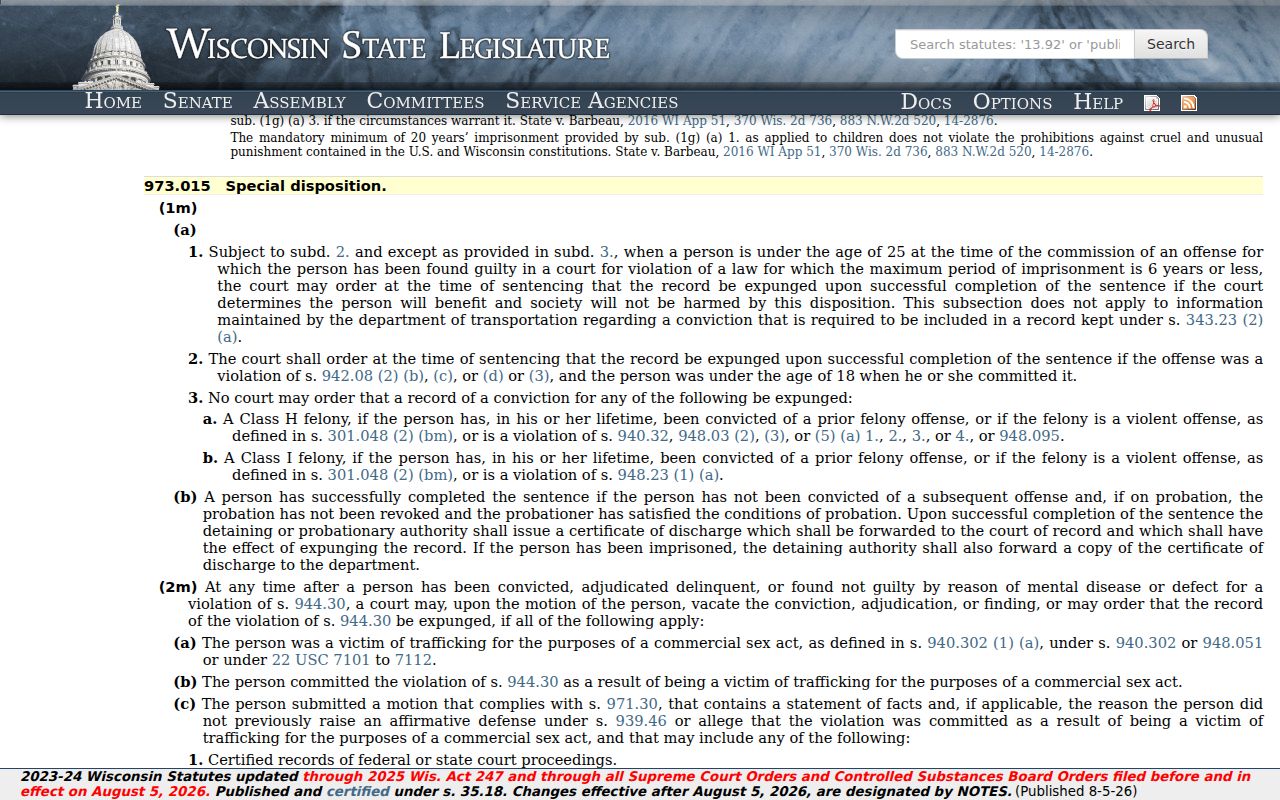
The statute screenshot ties any Florence County request to the actual Wisconsin rule, rather than a broad assumption that every old case can be sealed later.
Start with the WCCA sentencing entry, then ask the clerk whether expungement was ordered and obtain the judgment. Successful completion may require a certificate from the responsible agency. Court expungement does not by itself erase an independently held police record or CIB criminal-history entry. If CIB lacks a disposition or has mistaken identity data, use DOJ's separate challenge process with certified supporting records.